
Why Do I Wake Up at 3am? What Causes It and What Helps
The waking is normal. The lying there for two hours afterward is the part worth fixing.

If you have ever asked yourself why you wake up at 3am, night after night, while the rest of the house sleeps, you are not imagining a pattern.
Waking in the small hours is one of the most common sleep complaints there is, and in most cases it is not a sign that something is wrong with you. It is a sign that something in your night, your day, or your body's timing has shifted.
This article covers what is actually happening in your body around 3am, the reasons it keeps happening, why it so often starts in midlife, the handful of cases where it is worth speaking to a doctor, and what to do when you are lying there wide awake at 3:14 in the morning.
The short answer
You wake at 3am because by that point in the night your sleep is naturally at its lightest, so it takes very little to pull you out of it.
Everyone surfaces briefly between sleep cycles. Most of the time you never notice, roll over, and drop straight back down. You notice the 3am one because something else is layered on top of it: a full bladder, a warm room, a racing mind, alcohol wearing off, a hot flash, or a body clock that has drifted out of step with your alarm.
The waking is normal. The staying awake is the part worth fixing.
What your body is actually doing at 3am
Sleep is not one flat state. You move through it in cycles, and those cycles are not identical.
According to the National Heart, Lung, and Blood Institute guide to sleep phases and stages, the cycle "starts over every 80 to 100 minutes," and "usually there are four to six cycles per night." Crucially, the makeup of those cycles changes as the night goes on. You "usually spend more time" in deep sleep "early in the night," while "you usually have more REM sleep later in the night."
That matters. Deep sleep is the heavy, hard to disturb kind. REM sleep is lighter and closer to the surface.
So if you go to bed at 10pm, your deepest and most protected sleep is largely behind you by around 2am to 3am. What remains is lighter sleep and REM, and as the same NHLBI page notes, "you may wake up briefly between cycles."
At roughly the same time, your body chemistry is shifting. Melatonin, the hormone that rises to help you sleep, "starts to increase in the evening and peaks in the early morning," while cortisol, released as light increases, "naturally prepares your body to wake up," according to the NHLBI explanation of your sleep and wake cycle.
In other words, 3am is the hinge of the night. Your sleep is thinning out and your body has begun the slow work of getting ready for morning. If you want the full picture of how the night is structured, our breakdown of the four stages of sleep walks through each one.
The most common reasons you keep waking at 3am
Stress and a mind that will not switch off
The NHS lists "stress, anxiety or depression" first among the most common causes of insomnia. This is the single biggest driver of 3am waking in otherwise healthy people.
The mechanism is unkind. You surface naturally between cycles, your brain notices it is awake, and instead of drifting back it starts working. Tomorrow's meeting. The email you should have sent. Money. Once that starts, light sleep becomes no sleep.
Alcohol in the evening
A drink makes you fall asleep faster, which is why people trust it. The problem arrives later. As your body clears the alcohol, sleep becomes fragmented, and the disruption lands squarely in the second half of the night.
The NHS advice is direct: "do not smoke or drink alcohol, tea or coffee at least 6 hours before going to bed."
Caffeine that is still working
Caffeine lasts far longer than most people assume. An afternoon coffee can still be active in your system at bedtime, shallowing your sleep enough that a normal between-cycle waking becomes a full one.
A room that is too warm
Bedroom temperature is one of the easiest fixes and one of the most overlooked. The NHS names "a room that's too hot or cold" among its common causes, and advises you "make sure your bedroom is dark and quiet."
Needing the bathroom
One trip after a late cup of tea is ordinary. What is not ordinary, and what tends to get brushed aside, is waking to urinate every night when you stopped drinking at five or six in the evening and emptied your bladder before bed.
At that point it is not a fluids problem, and answers along the lines of drinking less in the evening have already been tried. Something else is producing or holding urine differently overnight, and that is worth asking about rather than living with. Frequent night urination is also a listed symptom of sleep apnea.
Mention the getting up as well as the waking. If you stand up dizzy or disoriented in the dark, say so, because blood pressure that drops on standing is common, easy to check, and a real risk of falling at 3am. It can also be affected by what medication you take and what time you take it, which is a question for your doctor or pharmacist rather than something to adjust yourself.
Getting older
Sleep genuinely changes with age, and not gently. NHLBI notes that slow-wave sleep "continues to decrease through adulthood, and older people may not have any slow-wave sleep at all."
Harvard Health describes the same shift plainly in its article on being too early to get up and too late to get back to sleep: "as we grow older, the normal sleep cycle becomes shorter, and we spend less time in deep sleep."
Less deep sleep means less of the sleep that resists disturbance. The same noise that would not have touched you at 25 wakes you fully at 55.
Physical discomfort
Sometimes the cause is simply your body. Nighttime leg cramps and restless legs syndrome both tend to strike in the second half of the night, exactly when your sleep is already light enough to be interrupted.
Waking at 3am during perimenopause
If your 3am waking started in your forties or fifties, this section is probably the one you came for.
Here is what it actually looks like, in the words women use about it. Waking soaked and then freezing. Flipping the pillow because that side is wet too. Keeping spare bedding beside the bed so the change takes five minutes instead of twenty, because five minutes might still leave you time to fall back asleep. Showering at 4am. Running out of pajamas. Dreading going to bed at all.
That is not a delicate inconvenience and it is not you being dramatic. It is a physical event that happens to your body while you are unconscious, and it can go on for years.

I will add my own, because it changes what you should expect. Mine was, by any measure, a light menopause. I still woke up wet often enough that changing the sheets became an ordinary part of the night. Not every night. Often enough. So if you have been told your symptoms sound mild and you are still stripping the bed at 3am, those two things are not in conflict, and you have not misunderstood your own body.
What is actually happening
The National Institute on Aging is direct about the mechanism. During the menopausal transition, it says, "the body's production of estrogen and progesterone, two hormones made by the ovaries, declines greatly." Changes in those hormones, it adds, "may explain the symptoms that some women experience during this time."
Trouble sleeping and night sweats are both named on that list, alongside hot flashes, joint and muscle discomfort, moodiness, forgetfulness and difficulty concentrating.
The timing is worth knowing, because nobody tends to mention it in advance.
- Most women begin the menopausal transition between 45 and 55.
- Symptoms can last between two and eight years.
- The timing and the symptoms vary enormously between women, influenced by genetics and by factors such as smoking.
Two to eight years is the number that tends to land hardest, and it is the honest one. If you are a year into this and wondering when it stops, that is why the answer you keep getting is vague.
Which comes first is not settled
The obvious story is that a hot flash wakes you. That may not always be the order. Writing on sleep problems and menopause, NIA notes that "research now suggests that waking from sleep itself may trigger hot flashes, rather than the other way around."
That is worth knowing for one practical reason, and it is not that your night sweats are imaginary. They are not. It means the ordinary things that make waking more likely are still worth attention in midlife, because they may be feeding the cycle rather than sitting outside it. A warm room. A late glass of wine. An afternoon coffee. An irregular wake time. None of those caused perimenopause, and none of them are your fault. They are the levers still within reach when the hormonal part is not.
What women say makes a difference
The thing raised most often in menopause communities is hormone therapy, and the experiences split. Some women describe night sweats stopping within days. Others are on it and still wake at 3am. It is a real conversation to have with a doctor rather than a decision to make from an article, and NIA's own advice is that women concerned by menopausal symptoms should talk with a doctor about lifestyle changes or medications that might help.
Beyond that, the practical things women report are unglamorous and cheap to try.
- What you sleep in and on. Natural fibers over synthetics. Wool and cotton move moisture in a way that polyester and fleece do not, and a "breathable" mattress protector is often neither.
- A colder room than feels reasonable. Colder than you would choose while awake.
- Alcohol, and sugar late in the day. Alcohol comes up more than anything else here, and it lands in the second half of the night, which is exactly where your sleep is already thin.
- Something cold within reach. Not to sleep on, just to reach for, so a flash does not mean getting up.
NIA's own list for this stage overlaps almost entirely with the general advice further down this page: a regular sleep schedule, a bedtime routine, a bedroom kept "at a comfortable temperature, not too hot or too cold", no large meals close to bed, no late caffeine, and exercise during the day but not near bedtime. On alcohol it is blunt: "Even small amounts make it harder to stay asleep."
Where its advice goes further is what to do when that is not enough. NIA points to cognitive behavioral therapy for insomnia, a structured short course of talking therapy, which "has been shown to help improve sleep in women with menopausal symptoms." It has more evidence behind it than most things on this page and is rarely offered first. On the over-the-counter route it is careful: sleep aids such as melatonin "are not a cure for sleep disturbances, such as insomnia, and should not be used long term."
The maddening part, and what to do with it
One night you sleep like the dead. The next two you are pouring. Same bed, same room, same you. That inconsistency is what women describe as hardest to live with, because it makes the whole thing feel random.
It is usually not random. The triggers are small, they are spread across the previous day, and nobody can hold two weeks of that in their head. This is the best argument there is for writing it down, which is what the last section of this article is about.
It has a second use. If you have ever had something you were feeling waved away, you already know that "I am not sleeping" is easy to dismiss and a page of dated entries is harder. You are the one living in your body, and you do not have to understand the mechanism to know something has changed. A written record is simply the form of that which is hardest to argue with.
Talk to your doctor if your sleep changed around perimenopause and has stayed changed, if night sweats are soaking your bedding regularly, or before starting any supplement or sleep aid while you take medication for blood pressure, thyroid problems, diabetes, depression or anxiety, or a blood thinner. Interactions are the reason. Drenching night sweats can also have causes that have nothing to do with menopause, so they are worth raising rather than assuming.
Pregnancy brings its own version of broken sleep, which we cover separately in insomnia during pregnancy.
Asleep by nine, wide awake at three: when your body clock runs early
One pattern looks exactly like insomnia and may not be.
You are fighting to keep your eyes open by 8 or 9pm. You fall asleep the moment your head lands. Then at 3am you are awake, properly awake, and nothing will put you back under.
If that is you, your sleep may not be broken. It may just be early.
Sleep doctors have a name for the far end of this: advanced sleep-wake phase. The National Heart, Lung, and Blood Institute describes it as finding it "very difficult to stay awake in the early evening and as a result, wake up too early in the morning."
The American Academy of Sleep Medicine puts the waking between 2 and 5 in the morning, and adds the part that matters most: "While the timing of sleep is early, sleep itself is normal."
Keep it in proportion. The AASM calls the full disorder "not very common," about 1% of middle-aged adults, though "more common in older adults and seniors." Most 3am waking is still the everyday causes above. And early waking on its own proves nothing, because the NHS lists "wake up early and cannot go back to sleep" as a plain insomnia symptom.
What tells them apart is the whole pattern, not the one hour. The AASM says people often mistake an early clock for insomnia or depression, and that a doctor spots it from a sleep diary, sometimes kept "over several weeks." That is one more reason for the seven nights below.
Where the light advice turns around
Most sleep advice, including this article further down, says get daylight in the morning. For an early body clock, that pushes things the wrong way.
NHLBI's own instructions for a light box are plain: "To move your sleep and wake times later, use the light box late in the afternoon or early in the evening." Used when you wake up in the morning, the same box moves sleep and wake times earlier. Same lamp, opposite result.
So if you are trying light therapy to sleep later, the timing is the whole trick. None of the sources gives an exact hour, and we are not going to invent one.
The AASM says light therapy is "one part of a treatment plan that should be guided by a sleep doctor."
Ask your doctor before you start if you have an eye condition such as glaucoma, cataracts or eye damage from diabetes, if you take medicines that make you sensitive to light, or if you have bipolar disorder, where too much light too fast may bring on manic symptoms.
Melatonin timing is specialist territory too: the AASM says its use for a body clock problem should be overseen by a sleep doctor, and that it may be unsafe alongside some medicines, including those for mental health.
When 3am waking is worth taking to a doctor
Most 3am waking is a habit and environment problem. Some of it is not.
Speak to a healthcare professional if any of the following apply.
- You wake gasping or choking, or someone has told you your breathing stops and starts. NHLBI lists "breathing that starts and stops," "frequent loud snoring," and "gasping for air" among sleep apnea symptoms, alongside waking often during the night to urinate.
- You snore heavily and wake unrefreshed no matter how long you were in bed. Our comparison of snoring versus sleep apnea explains where the line sits, and the two types of sleep apnea covers how they differ.
- Your low mood or anxiety is driving the waking rather than the other way around.
- It has been going on for months and is affecting your days.
The NHS guidance is to see a doctor if "changing your sleeping habits has not helped your insomnia," if "you've had trouble sleeping for months," or if "your insomnia is affecting your daily life."
Sleep apnea in particular is worth ruling out, because it is common, treatable, and frequently missed for years.
A smartwatch that logs a dozen wakings a night is a reason to ask, not a diagnosis. The American Academy of Sleep Medicine says consumer sleep trackers "cannot be utilized for the diagnosis and/or treatment of sleep disorders at this time." And you do not have to snore. NHLBI notes that "some women with sleep apnea do not snore" and lists fatigue, headache and insomnia as more common in women.
What to do when you are awake at 3am
The goal is not to force yourself back to sleep. Forcing does not work, and trying harder makes it worse.
Do not look at the clock. Harvard Health is blunt about this: "Don't watch the clock. Watching the sleepless minutes pass makes it harder to fall back to sleep." The advice is to "turn the clock face so you can't see it." Knowing it is 3:47 and your alarm goes at 6 adds arithmetic and dread to a body that needs neither.
Keep the lights off. Bright light tells your body clock that morning has arrived. If you must get up, use the dimmest light that keeps you safe.
Leave your phone alone. A screen at 3am is both light and stimulation, and the NHS advises against using devices right before bed for the same reason.
If you are still awake after around twenty minutes, get up. Lying in bed frustrated teaches your brain to associate the bed with being awake. Go to another room, do something quiet and dull in low light, and return when you feel sleepy.
Slow your breathing. Long, slow exhales that last longer than your inhales help settle physical arousal. It will not knock you out, but it stops the spiral.
What to change during the day
The 3am fix mostly happens between 7am and 10pm.
- Get up at the same time every day, including weekends. The NHS puts this near the top of its list: "wake up and get out of bed at the same time every day." A fixed wake time anchors the whole system.
- Get daylight early. NHLBI calls light "the strongest signal in the environment to help reset your sleep-wake cycle." One exception: if you are fighting sleep by early evening and awake for good at 3am, read the early body clock section first, because for that pattern the timing of light changes the answer.
- Get outside again later in the day. NHLBI's advice is to "spend time outside every day (when possible)," and it notes that you "may need more sunlight during the day and less artificial light at night." The same exception applies: with an early body clock, when you get the light matters more than how much.
- Move your last drink earlier, or skip it. Six hours before bed is the NHS benchmark for alcohol and caffeine both.
- Stop eating large meals late. The NHS advises against a big meal late at night.
- Cool the bedroom and make it properly dark.
- Exercise during the day, but not in the four hours before bed.
- Do not nap to make up for a bad night, and do not sleep in the next morning. Both push the following night further out of shape. If you cannot get through the day without one, NHLBI's limit is "no more than 20 minutes," taken earlier in the afternoon rather than late.
When you are too tired to do any of that
There is a problem with the list above, and most articles skip it. It asks you to do the hardest thing at the exact moment you have least in the tank. After three bad nights you do not want to get up on time and stand outside. You want to stay in bed.
That is the loop. Bad night, no energy, sleep in to catch up, no morning light, body clock drifts further, next night is worse. The tired morning is not the obstacle to fixing this. It is the lever.
So here is the honest version of the instruction. Keep the wake time and drop everything else. You are not required to get up and be productive. Get up, get light on your face, then sit down and rest if you need to rest. Go back to the couch. The thing doing the work is the clock, not the activity, and it is the extra two hours in bed that undoes it, not the fact that you are tired afterward.
Daylight does not mean a walk either. Five to ten minutes is enough. Standing at an open door with a coffee counts. On a bad morning, do the smallest version rather than skipping it because you cannot do it properly.
One more thing nobody warns you about: it feels worse before it feels better. Holding a wake time when you are already short of sleep is genuinely unpleasant for the first few days. That is the cost, it is temporary, and it is why the two weeks below matter.
None of this is about discipline. If you are unwell, or in treatment, or your tiredness has a cause of its own, being told to try harder is useless. Keep the wake time, make everything else as small as it needs to be, and let the rest of the day be gentle.
If you would rather start with something simpler than a full overhaul, our guide to improving sleep quality without complicated routines keeps it to the few changes that carry the most weight, and how to get quality sleep at night covers what to do when poor sleep has already tipped into burnout.
What was happening when you woke up?
The clock tells you when you woke. It does not tell you why, and the why decides what is worth trying.
Four people can all say they wake at 3am and have almost nothing else in common.
One is soaked and throwing off the covers. One is dry and cool, with a heart that will not settle. One needed the bathroom. One heard a car door. From the ceiling, all four look like the same problem.
So the next time you surface, take a few seconds before you reach for anything and notice what was going on. Do not turn it into a job.
"No idea" is a fine answer. Write down what you noticed in the morning, using the list below.
- Hot, cold or damp. Were you sweating, or soaked and then chilled? Roughly how warm was the room, what were you wearing, and what was on the bed?
- Your heart. Racing or pounding, or steady? The note under this list matters.
- Your mind. A worry or a list going round in a loop, or nothing at all. Just awake.
- The bathroom. Did you need to go, or did you go because you were already up?
- Pain or discomfort. A cramp, restless legs, or a hip or shoulder that hurts in one position. Our guide to the best sleeping position covers that last one.
- Noise or light. A snoring partner, a pet, a phone lighting up, a streetlight through the curtain.
- What you took, and when. Any medication or supplement, and roughly what time. Caffeine and alcohol are already on the list in the next section.
- The hour, roughly. About the same time each night, or all over the place? Do not check the clock for this. A guess in the morning is enough. You are looking for a pattern, not a diagnosis.
A racing or pounding heart that keeps coming back, is happening more often, or lasts longer than a few minutes is worth telling a doctor about, even if you suspect anxiety or hormones. Do not wait for a diary to fill up before you say so.
If it does not settle, or comes with chest pain, heaviness or discomfort, shortness of breath, or feeling faint, call your local emergency number instead of waiting for morning. The NHS page on heart palpitations sets out when to get help.
If you take regular medication, note when you take it, but do not change the timing or the dose because of a pattern you spot. Bring the notes to your doctor or pharmacist and ask.
Track seven nights before you judge what is working
Here is the problem with everything above. You cannot tell what worked.
Change four things at once and have a good week, and you have learned nothing you can repeat. Change four things and have a bad week, and you will probably abandon all four, including the one that was helping.
So before you judge any of it, write down seven nights. Not a device, not an app that scores your sleep out of a hundred. Seven lines in a notebook.
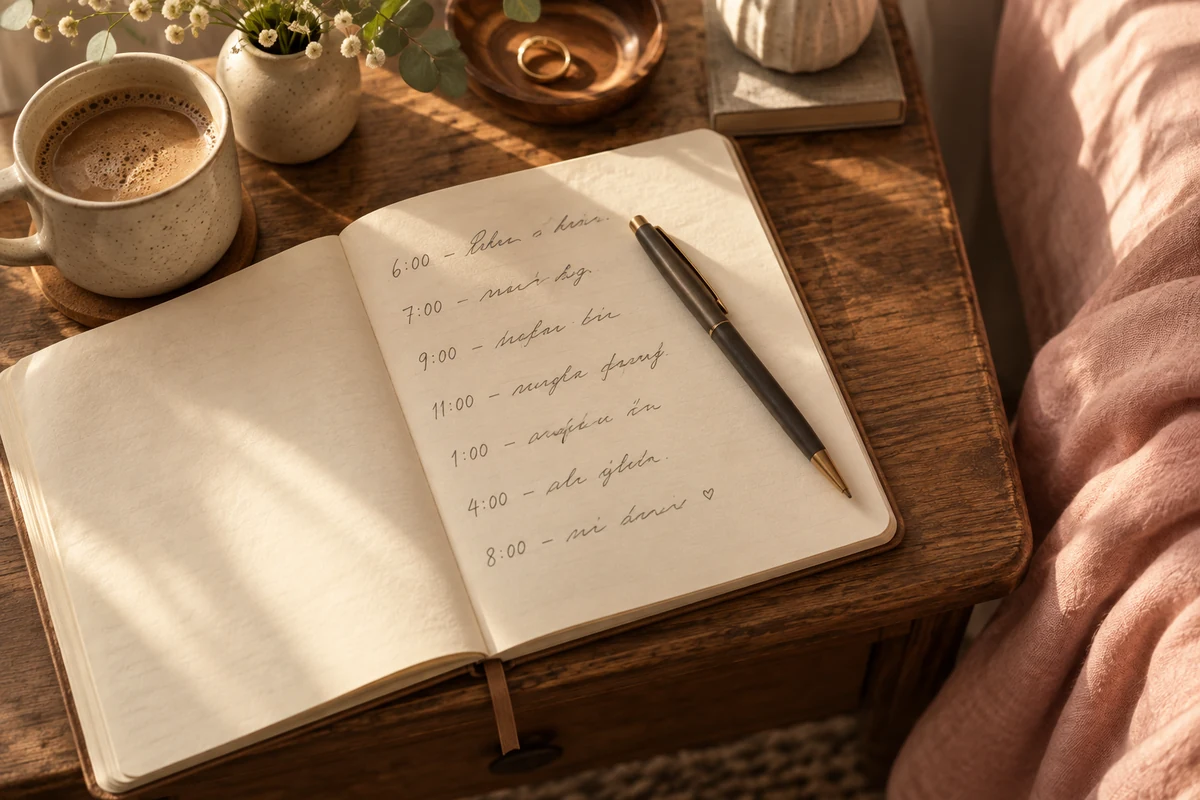
Record, each morning, while you still remember:
- roughly when you went to bed and when you think you fell asleep
- whether you woke, and roughly how long you were awake
- what was happening when you woke, from the list above. "No idea" is fine
- caffeine and alcohol, and what time
- any naps: when, and for how long
- when you were outside or near bright light, morning, afternoon or evening
- whether you were fighting to stay awake in the evening before bed
- how rested you felt in the morning, on a scale of one to five
Seven nights is enough to see whether 3am is a pattern or a bad week. Fourteen is better if the answer matters, and it is what NHLBI suggests when you are keeping a record for a doctor's appointment.
Then change one thing. Just one. Give it two weeks. Look at the lines again. It is slower than trying everything at once, and it is the only version that tells you anything.
Our guide to keeping a sleep diary has the full template, what each column is for, and what a diary can and cannot tell you.
This article is for general information and is not medical advice. Persistent night waking can have medical causes that need proper assessment. Talk to your doctor or pharmacist about ongoing sleep problems, especially if you are pregnant or breastfeeding, or if you take regular medication, including blood thinners, antidepressants, or medication for blood pressure, thyroid problems or diabetes. Do not start or stop any supplement or sleep aid on the strength of an article.
Common questions about waking at 3am
- Is waking at 3am every night a medical problem?
- Usually not on its own. Brief awakenings between sleep cycles are normal, and NHLBI confirms you may wake up briefly between cycles. It becomes a medical question when you cannot get back to sleep for long stretches, when it has continued for months, or when it comes with gasping, choking or heavy snoring.
- Why 3am specifically and not some other time?
- There is nothing special about the number. It reflects when most people go to bed. Roughly five hours after falling asleep, deep sleep is largely finished and the rest of the night is lighter and easier to interrupt. Shift your bedtime and the waking time tends to shift with it.
- Does a spike in cortisol wake me at 3am?
- A hormonal explanation is often right, but the specific 3am cortisol spike version is the shakiest part of it. NHLBI describes cortisol as being released as light increases, preparing your body to wake up. In perimenopause, the steep decline in estrogen and progesterone is far better documented than any cortisol spike.
- Is waking at 3am a sign of perimenopause?
- Often, yes. Trouble sleeping and night sweats are both named by the National Institute on Aging among the symptoms of the menopausal transition, which most women begin between 45 and 55. It is not proof on its own, but if the waking arrived alongside other changes, it is worth raising rather than waiting it out.
- Can magnesium help me stay asleep?
- Some people find it helpful, particularly where cramps or restlessness are part of the picture. It is not a treatment for insomnia and it will not fix a body clock that has drifted. Results vary. If you take regular medication, check with your doctor or pharmacist before adding anything.
- Should I just get up and start my day?
- Only if it is genuinely close to your normal wake time. Getting up at 3am and starting work teaches your body to wake at 3am. If it is hours early, keep the lights low and treat it as night rather than morning, even if you cannot fall back asleep.
Sleeping through the night again
If you take one thing from this, make it the fixed wake time. It is unglamorous, it is free, and it does more to rebuild a broken night than any supplement or gadget.
Give it two weeks before you judge it. Keep the bedroom cool and dark, move alcohol and caffeine well away from bedtime, and stop looking at the clock when you surface.
If cramps, restlessness, or general tension are part of what is waking you, magnesium is worth understanding before you buy anything. We look at the evidence in does magnesium glycinate help you sleep, and our review of LiveGood Ultra Magnesium Complex covers what it contains and who it suits. It is not a treatment for insomnia. Results vary.
And if you wake gasping, snore heavily, or have been fighting this for months, book the appointment. Sleep apnea and long-running insomnia are both treatable, and neither improves by waiting.