
Best Sleeping Position: What Actually Matters
Side, back or stomach, and the handful of reasons the answer changes.
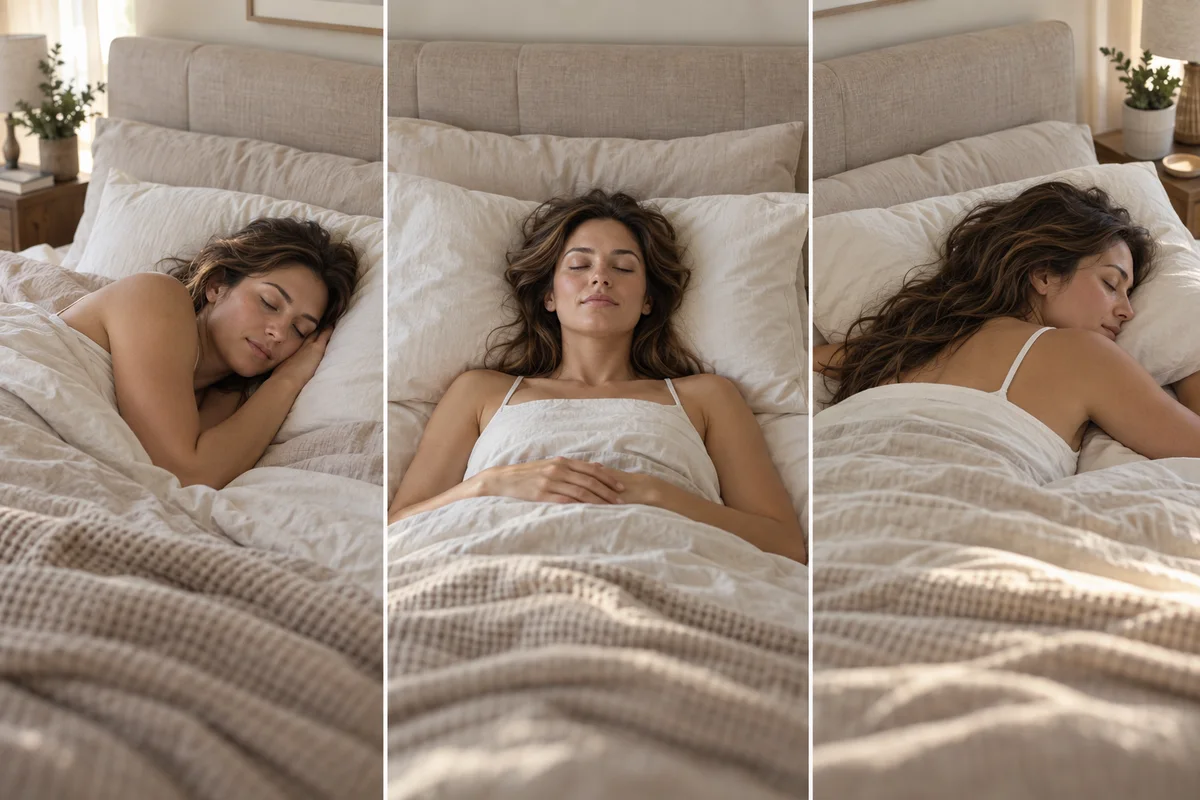
You can spend a surprising amount of time trying to sleep "correctly." Side or back. Left side or right. One pillow or two.
And if you wake with a stiff neck, a sore hip or an aching lower back, it is tempting to assume your sleeping position must be the thing that is wrong.
The useful answer is less dramatic than that.
There is no single best sleeping position for every adult. Comfort, pain, breathing, reflux and pregnancy can all change what works for you, and they change it in different directions.
Johns Hopkins sleep neurologist Rachel Salas puts it plainly. For young, healthy people, she says, sleep position is less important. As you get older and have more medical issues, it can become positive or negative.
So rather than forcing yourself into somebody else's perfect position, it helps to understand the trade-offs.
Is side sleeping the best position?
For a lot of people, side sleeping is a comfortable starting point.
It gets more interesting when snoring or obstructive sleep apnea is in the picture. Salas notes that lying on your side or stomach can help the airways stay open, which may reduce snoring and ease mild apnea.
Positional changes do not replace diagnosis or treatment. They are still a reasonable thing to try.
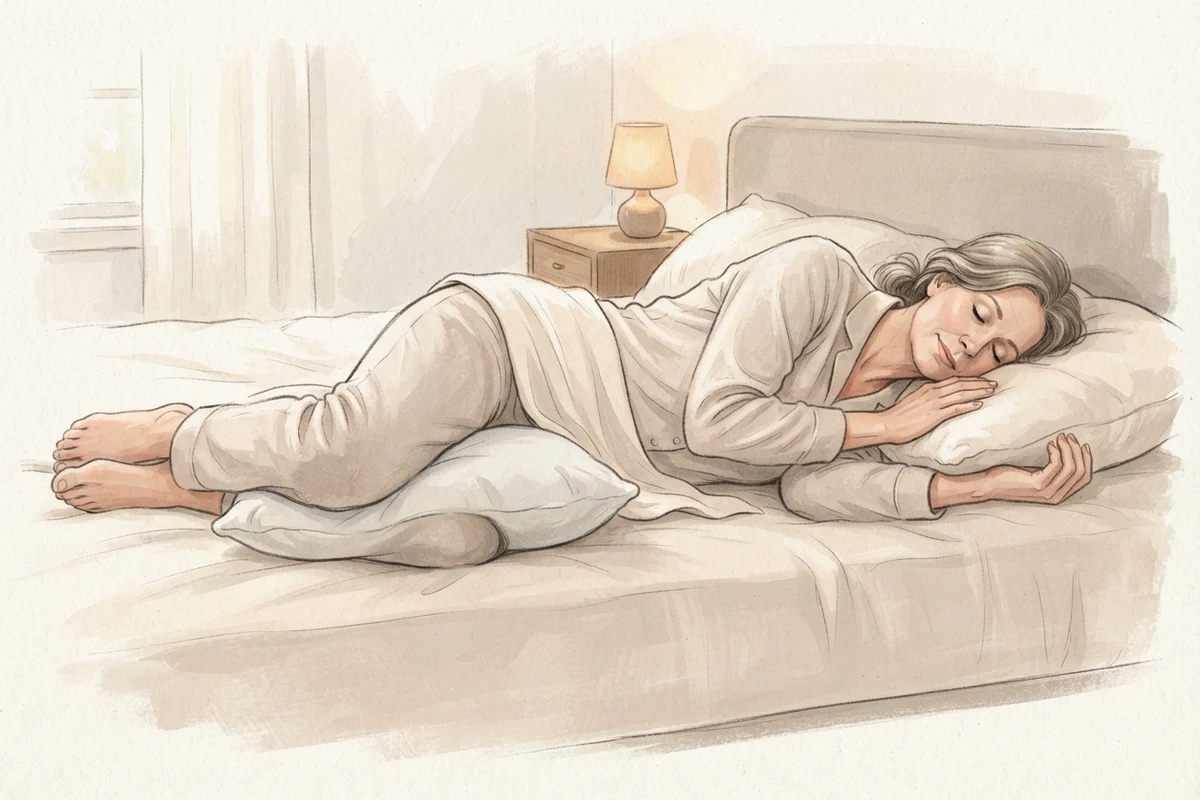
If your back is the problem rather than your breathing, Mayo Clinic suggests drawing your legs up slightly toward your chest and putting a pillow between your legs.
Bent knees with a pillow between them can help align your spine, pelvis and hips. That takes some pressure off the spine.
None of that means everyone should immediately become a side sleeper.
If side sleeping creates shoulder pressure, hip discomfort or numbness, your body is giving you information worth paying attention to.
The position has to work for you.
Left side or right side?
For most healthy adults, comfort is a reasonable guide. In two situations the side you pick may matter more.
If heartburn or reflux bothers you
Salas says sleeping on your right side can make heartburn worse. That holds both for people with diagnosed reflux disease and for people whose heartburn has another cause.
Flipping to the left side may help.
If reflux is a diagnosed problem rather than the occasional late dinner, position is only part of it. NIDDK's advice is to raise your head and upper back by six to eight inches, using a foam wedge or extra pillows so your whole upper body is inclined.
That is not the same as stacking pillows under your neck, which mostly just bends your neck.
And if reflux regularly wakes you, treating the underlying problem matters more than chasing the perfect angle. Talk to your doctor or pharmacist, particularly if you already take medication for it.
During pregnancy
Later pregnancy is the other exception.
ACOG advises that sleeping on your side during the second and third trimesters may be best, with one or both knees bent, a pillow between the knees and another under the belly.
Lying on your back later in pregnancy puts the weight of the uterus on the spine, and may compress a major blood vessel.
Pregnancy advice belongs with your own obstetric care, especially if you have any complications or significant discomfort. Take this to your midwife or obstetrician rather than settling it from an article.
Is sleeping on your back bad?
Not necessarily. Back sleeping is genuinely comfortable for some people.
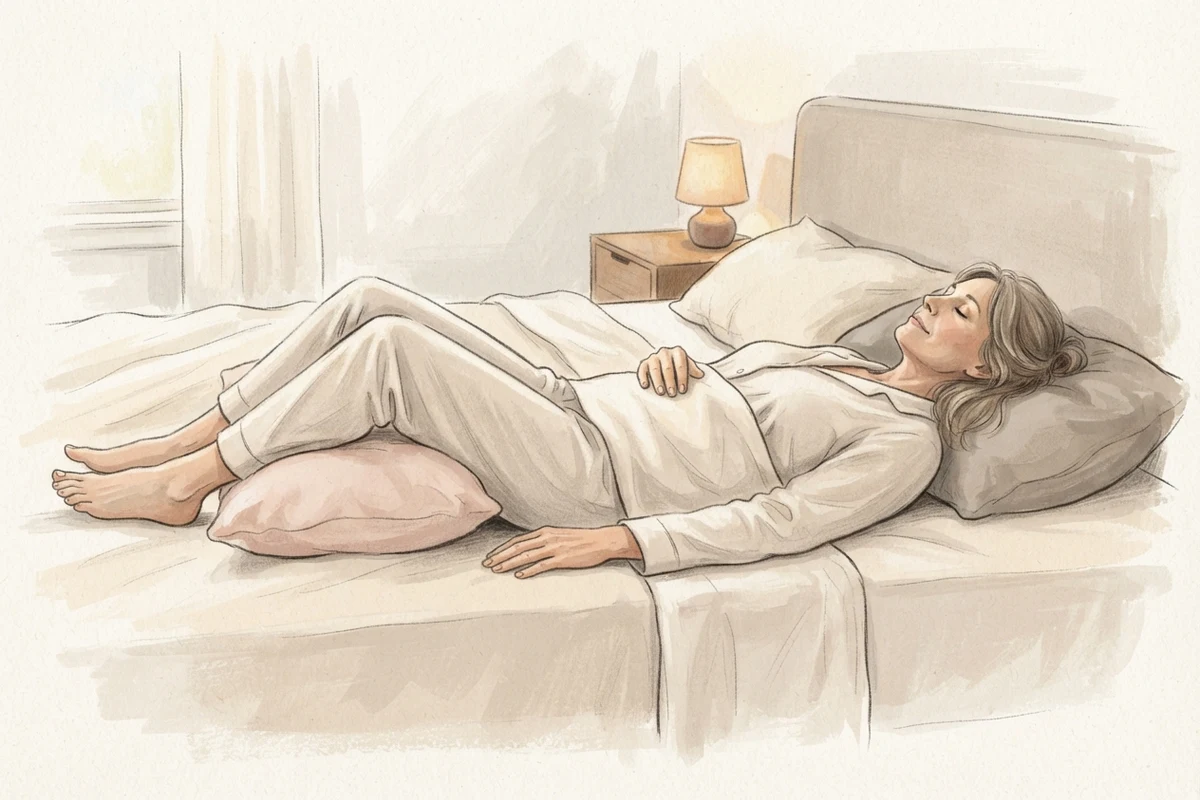
For lower-back comfort, Mayo Clinic suggests placing a pillow under your knees. That may help relax the back muscles and keep the natural curve of your lower back.
Your head pillow should support your neck without pushing it forward, keeping it roughly in line with your chest and back.
Back sleeping becomes less attractive when it makes snoring or sleep apnea worse.
Mayo Clinic's own self-care advice for obstructive sleep apnea is to sleep on your side or stomach rather than your back. Lying on your back can let the tongue and soft palate rest against the back of the throat and block the airway.
Snoring may be loudest, and apneas more common, in that position.
If someone regularly tells you that you stop breathing, gasp or choke in your sleep, rolling over is not the answer.
That belongs in a proper assessment. Our guide to snoring versus sleep apnea covers how to tell the two apart.
What about sleeping on your stomach?
Stomach sleeping has a bad reputation.
It is not automatically dangerous. It can be harder on the back and neck, mostly because your head has to turn to one side for hours.
Mayo Clinic's suggestion is to try other positions if stomach sleeping is aggravating your back.
If you cannot sleep any other way, placing a pillow under your hips and lower stomach may reduce the strain. Your head pillow may need to be thin enough that it does not push your neck further out of line, and Mayo notes you can use one if it does not strain your back.
That is not the same as the advice you sometimes see to throw your pillow away.
The goal is comfort and reasonable alignment, not obeying a universal pillow rule.
Which sleeping position is best for back pain?
No single answer works for every kind of back pain. Mayo Clinic recommends two adjustments often enough that they are worth trying before anything else:
- Side sleeping, knees drawn up slightly, with a pillow between the knees.
- Back sleeping, with a pillow under the knees.
If stomach sleeping is the thing aggravating your back, moving to one of those two is the experiment.
Persistent pain is a different matter from ordinary morning stiffness. Pain that is getting worse, that keeps disturbing your sleep, or that comes with weakness or numbness deserves a proper assessment rather than another round of pillow experiments.
Which sleeping position is best for snoring?
Side sleeping is usually the first thing worth trying. Both Mayo Clinic and Johns Hopkins note that lying on your back can narrow the upper airway and make snoring worse for some people.
But snoring is not automatically a harmless noise problem. If it comes with any of these, sleep apnea should be considered:
- witnessed pauses in breathing
- gasping or choking
- marked daytime sleepiness
- morning headaches
- difficulty staying alert
Position may help some people. It is not a substitute for diagnosis or for treatment you have been prescribed.
Pillow or no pillow?
Pillow or no pillow is usually the wrong question. The better one is whether your pillow keeps your head and neck reasonably in line in the position you actually sleep in.
A side sleeper has more space to fill between the shoulder and the head than a back sleeper does, so the same pillow rarely suits both. A stomach sleeper is often more comfortable with something thinner.
No universal number of inches works for everybody.
Your mattress changes the answer too. If your shoulder sinks deep into a soft mattress, the pillow height that works there is not the one you would need on a firm one.
How many pillows should you sleep with?
As many as you need, as long as each one is doing a job. That might mean:
- one supporting your head and neck
- one between your knees when you sleep on your side
- one under your knees when you sleep on your back
More pillows are not automatically better. Fewer are not automatically healthier.
If you have stacked three under your head because one feels too low, you may simply be compensating for a pillow that does not fit the way you sleep.
The goal is support, not pillow arithmetic.
Before buying anything, try this
If you wake up uncomfortable, you do not need a new mattress, an orthopedic pillow, a cooling pillow and a body pillow by tonight. Start with what you already own, and spend a week noticing:
- which position you actually fall asleep in
- which position you wake up in
- whether the discomfort is in your neck, shoulder, hip or lower back
- whether a simple knee or leg support feels better
- whether snoring seems worse on your back
- whether reflux is worse in a particular position
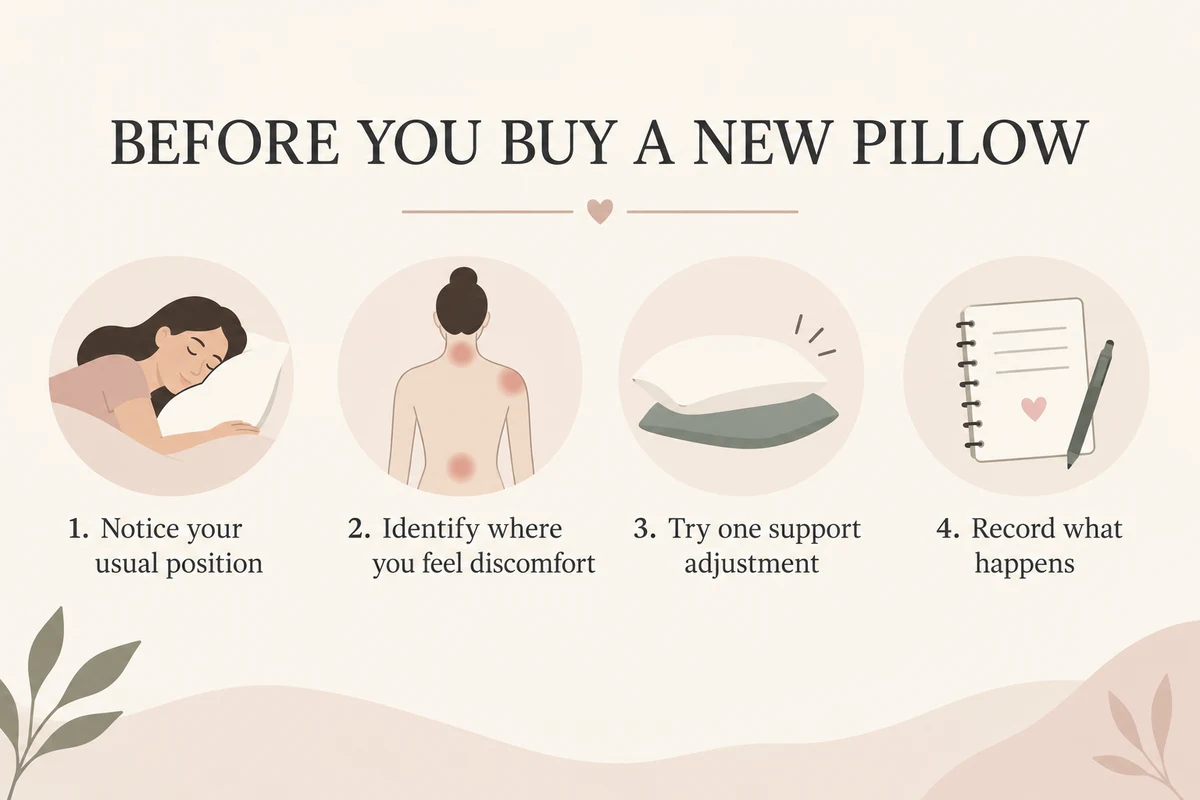
Then change one thing.
Not everything at once, or you will never know which change did the work.
A sleep diary makes this much easier. It lets you record comfort, waking and position instead of relying on your memory of one night.
When position is probably not the whole problem
Adjusting your position can make you more comfortable.
It cannot explain every sleep problem, and it is not treatment.
Get medical advice when there is:
- persistent or worsening pain
- numbness or weakness
- repeated choking or gasping during sleep
- breathing pauses that someone else has noticed
- severe daytime sleepiness
- persistent reflux symptoms
- pregnancy concerns that are not settling with ordinary comfort adjustments
A pillow can support you. A sleeping position can make you more comfortable. Neither is treatment for a medical condition, and neither should be sold to you as one. If you take medication for reflux, blood pressure, thyroid problems, diabetes, depression or anxiety, or you are pregnant or breastfeeding, talk to your doctor or pharmacist before changing anything you take.
This article is for general information and is not medical advice. Sleeping positions and pillows are comfort measures, not treatments. Talk to your doctor about persistent pain, breathing problems during sleep, ongoing reflux, or any pregnancy concern.
Best sleeping position FAQ
- Which sleeping position is best overall?
- No single position is best for every healthy adult. Side sleeping may help with snoring and some breathing problems, while back sleeping is more comfortable for some people with lower-back discomfort. What suits you depends on your own comfort and health.
- Is it better to sleep on the left or right side?
- For many people either side is fine. Johns Hopkins notes that right-side sleeping can make heartburn worse and that switching to the left side may help. In later pregnancy, ACOG suggests side sleeping generally rather than one particular side.
- What is the best sleeping position for lower-back pain?
- Mayo Clinic suggests two options. Side sleeping with your knees drawn up slightly and a pillow between your legs, or back sleeping with a pillow under your knees. Both are meant to take strain off the spine.
- Does sleeping on your back make snoring worse?
- It can. Mayo Clinic notes that lying on your back can let the tongue and soft palate rest against the back of the throat and block the airway, and that snoring may be loudest and apneas more common in that position.
- Should I sleep with one pillow or two?
- There is no ideal number. Use enough support to keep your head and neck comfortable in the position you actually sleep in, without pushing your neck out of line with the rest of your spine.
- Is stomach sleeping unhealthy?
- Not automatically. It can put more strain on the back and neck, because your head usually has to turn to one side. Mayo Clinic suggests trying another position if stomach sleeping is aggravating your back.
The best position is the one that fits the problem
There is no trophy for sleeping on your left side.
You do not need to force yourself onto your back because somebody online called it healthier.
Start with comfort.
Then ask whether you have a specific reason, such as back pain, snoring, reflux or pregnancy, that makes one position worth trying.
Make one adjustment, see what happens, and write it down.
If the problem keeps going, move past the pillow experiments and get it assessed. That is a more useful definition of the best sleeping position than pretending one pose works for everyone.
If you want the wider picture of what makes sleep restorative in the first place, start with our guide to quality sleep.