
Sleep Diary: What to Track and Why It Helps
Turning a vague sense of sleeping badly into something you can actually look at.

One bad night is easy to remember. A week of restless sleep is different.
Was Tuesday the night you woke at 3 AM? Did you have coffee late that afternoon? Were you awake for ten minutes or an hour? Did you nap the next day because you were exhausted? After several nights, the details start blending together.
That is where a sleep diary becomes useful.
A sleep diary is simply a written record of when you sleep, when you wake, how rested you feel, and some of the daytime habits that may affect your nights. It does not diagnose a sleep disorder. What it can do is turn a vague feeling of "I'm sleeping badly" into something more useful.
The National Heart, Lung, and Blood Institute suggests keeping a sleep diary for 1 to 2 weeks before seeing your doctor about insomnia, recording when you go to sleep, wake up and nap, how sleepy you feel during the day, and when you have caffeine, alcohol or exercise. If you want the wider picture first, our guide to why restorative sleep matters covers the stages and what affects them.
What is a sleep diary?
A sleep diary is a daily record of your sleep and the things around it.
Unlike a smartwatch or fitness tracker, you are not asking a device to estimate what stage of sleep you were in. You are recording what you actually remember and observe.
That can include:
- when you went to bed
- roughly when you fell asleep
- how often you woke during the night
- how long you were awake
- your final wake-up time
- when you got out of bed
- naps
- caffeine and alcohol
- medicines that may affect sleep
- exercise
- how sleepy you felt during the day
- how rested you felt when you woke
NHLBI specifically includes sleep timing, naps, caffeine, alcohol, exercise and daytime sleepiness among the information that may help a clinician understand a sleep problem.
You do not need to turn this into a nightly science project.
The goal is to collect enough information to see a pattern.
A simple sleep diary template
You can use a notebook, spreadsheet, printable page or notes app.
A basic entry might look like this:
| What to record | Example |
|---|---|
| Went to bed | 10:30 PM |
| Tried to sleep | 10:45 PM |
| Estimated time to fall asleep | About 30 minutes |
| Night waking | Woke twice |
| Final wake time | 6:15 AM |
| Got out of bed | 6:30 AM |
| Nap | 25 minutes at 2 PM |
| Caffeine | Coffee at 8 AM and 3 PM |
| Alcohol | None |
| Exercise | 30-minute walk |
| Morning feeling | Tired |
| Daytime sleepiness | Strong around 3 PM |
| Notes | Woke with dry mouth |
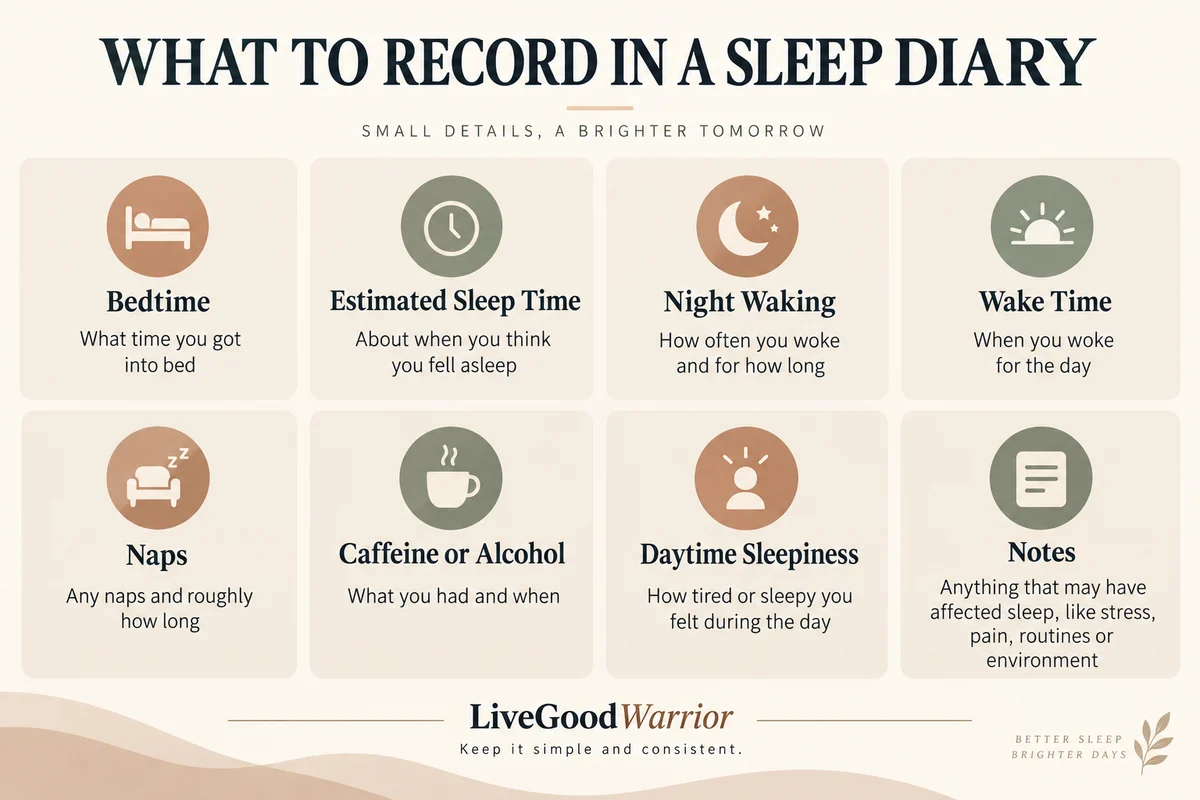
The important word here is estimated.
You do not need to watch the clock every time you wake up. In fact, constantly checking the time can make some people more preoccupied with sleep.
If you think you were awake for "a while," write that. If you know it was roughly half an hour, write that.
Useful beats perfect.
If you would rather not design your own, NHLBI publishes a printable sleep diary you can use exactly as it is.
How long should you keep a sleep diary?
If you are taking a sleep diary to a healthcare appointment, NHLBI suggests keeping one for 1 to 2 weeks.
That gives your clinician more than one unusually good or bad night to look at. For your own purposes, the same principle applies. Several nights are more useful than judging your sleep from one night alone.
Sleep naturally varies.
A stressful day, travel, illness, alcohol, an unusual bedtime or a noisy neighbor can all make one night different from the next.
You are looking for repetition.
What patterns can a sleep diary reveal?
A diary does not tell you why something is happening. It can show you when it tends to happen.
That distinction matters.
You may notice your schedule changes more than you thought
You may believe you go to bed around 10:30 every night, then discover the real pattern is:
- 10:15 Monday
- midnight Tuesday
- 11:30 Wednesday
- 9:45 Thursday
- 12:30 Friday
That does not automatically mean the changing schedule is causing your sleep problem. It gives you something concrete to look at.
You may see a connection with naps
A diary can show whether long or late naps tend to occur on the same days you struggle at bedtime. Again, that is a pattern, not proof of cause. It gives you a useful question to test.
You may discover caffeine is later than you realized
Coffee is obvious.
Tea, cola, energy drinks, chocolate and some medications can also contain caffeine. Recording the time rather than simply writing "had coffee" makes the diary much more useful.
You may see the same nighttime waking pattern
- Perhaps you regularly wake after a few hours.
- Perhaps waking happens mainly after drinking alcohol.
- Perhaps you wake hot.
- Perhaps you wake needing the bathroom.
- Perhaps you do not know why you woke at all.
These patterns can help you decide what deserves a closer look. They can also give a clinician much better information than "I wake up all night."
If the waking keeps landing in the small hours, our guide to why you wake up at 3am covers the common causes and what to note down when it happens.
What a sleep diary cannot tell you
This part is important.
A sleep diary is a tracking tool, not a diagnostic test.
It cannot tell you that:
- you have insomnia
- you have sleep apnea
- your cortisol is high
- your blood sugar dropped overnight
- you were deficient in a particular nutrient
- you achieved a certain amount of deep sleep
- one food or supplement caused your sleep problem
NHLBI notes that a sleep diary can help your doctor understand the problems you are having, while diagnosis itself may involve medical history, a physical examination, and tests such as a sleep study, actigraphy or blood work depending on the problem.
Think of your diary as evidence for a conversation, not a verdict.
Sleep diary or sleep tracker?
You do not need a smartwatch to keep a useful sleep record.
A sleep diary records your experience and context. A wearable usually estimates sleep from signals such as movement and heart rate. Those are different kinds of information.
Your diary may tell you:
I had coffee late, felt wired at bedtime, woke twice and was exhausted the next afternoon.
A tracker may tell you:
Estimated sleep duration: 6 hours 42 minutes.
Both can be interesting. Neither should be treated as a diagnosis. Medical sleep studies measure far more than a consumer wearable, including brain activity, breathing and oxygen levels when clinically indicated.
For now, if you do use a tracker, write the information in a separate column. Do not let a score override how you actually feel.
Use the diary to change one thing at a time
A sleep diary becomes more useful when it helps you stop changing everything at once.
Imagine you decide to:
- stop afternoon coffee
- buy a new pillow
- take magnesium
- move bedtime earlier
- stop using your phone
- start exercising
- change your evening meal
Then you sleep better.
Which change helped? You have no idea.
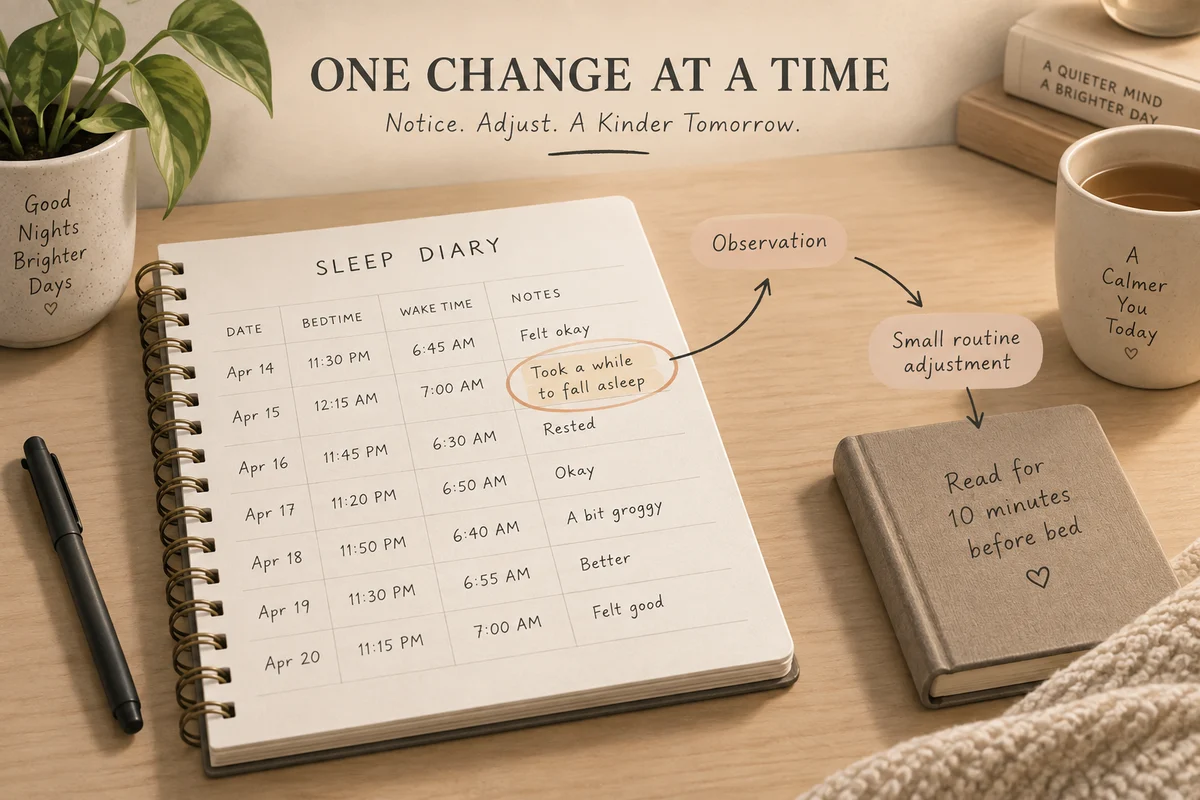
A simpler approach is to notice one reasonable pattern, make one practical adjustment where appropriate, and keep recording.
That does not mean every sleep problem can be solved through lifestyle changes. It means you can learn more without turning bedtime into a constant experiment.
When your sleep diary belongs in a medical appointment
Bring the diary with you if sleep problems are persistent or affecting your daytime functioning.
NHLBI specifically suggests sharing sleep diary information with a healthcare professional when insomnia is being assessed.
It is especially worth seeking professional assessment if you have symptoms such as:
- loud regular snoring with breathing pauses
- waking gasping or short of breath
- severe daytime sleepiness
- difficulty staying awake during ordinary activities
- persistent trouble falling or staying asleep
- sleep problems that are interfering with daily life
Sleep apnea, for example, requires proper assessment rather than a diary alone. Our comparison of snoring versus sleep apnea covers which symptoms belong in a doctor's appointment rather than a notebook.
If you are sleepy enough that driving feels unsafe, do not use a diary as a reason to wait for help. Speak to a healthcare professional now. The same applies if you are pregnant or breastfeeding, or if you take medication for blood pressure, thyroid problems, diabetes, depression or anxiety, and your sleep has changed. Talk to your doctor or pharmacist before changing anything you take.
This article is for general information and is not medical advice. A sleep diary is a record-keeping tool, not a test, and it cannot diagnose a sleep disorder. Talk to your doctor or pharmacist about persistent sleep problems, especially if you are pregnant or breastfeeding, care for a child with a sleep problem, or take regular medication.
Sleep diary FAQ
- What should a sleep diary include?
- At minimum, record bedtime, estimated sleep onset, nighttime waking, final wake time, naps and how rested or sleepy you feel. Adding caffeine, alcohol, exercise and medicines can provide useful context.
- How many days should I keep a sleep diary?
- If you are preparing for an appointment about insomnia, NHLBI suggests keeping one for 1 to 2 weeks before seeing your doctor.
- What if I cannot remember exactly when I fell asleep?
- Estimate it. A sleep diary is not expected to measure sleep with laboratory precision, and watching the clock through the night tends to make people more preoccupied with sleep, not less.
- Do I need an app to keep a sleep diary?
- No. Paper, a notes app or a spreadsheet can all work. NHLBI also publishes a printable sleep diary you can use as it is.
- Can a sleep diary diagnose insomnia or sleep apnea?
- No. It can provide useful information for you and your clinician, but diagnosis may require a broader clinical assessment and sometimes testing such as a sleep study, actigraphy or blood tests.
- Is a sleep diary better than a sleep tracker?
- They record different things. A diary captures your own observations and daily context. A tracker estimates sleep from sensor data. Neither replaces a clinical sleep assessment when one is needed.
The point is not to become better at tracking
It is easy to turn sleep into another thing to optimize. That is not the purpose.
Your sleep diary should help answer a few practical questions:
- What keeps happening?
- What seems different on better nights?
- What seems different on worse nights?
- Is there anything useful to discuss with a healthcare professional?
That is enough.
If your diary shows that several small habits may be working against you, the next step can be working through them systematically rather than trying another random sleep tip. The Live Good Warrior Sleep Like a High-Performer workbook is built for that stage, helping you work through your routine and your bedroom without needing to overhaul everything at once.