
Does Red Light Therapy Help Knee Pain?
What the studies found, and what still depends on the device.
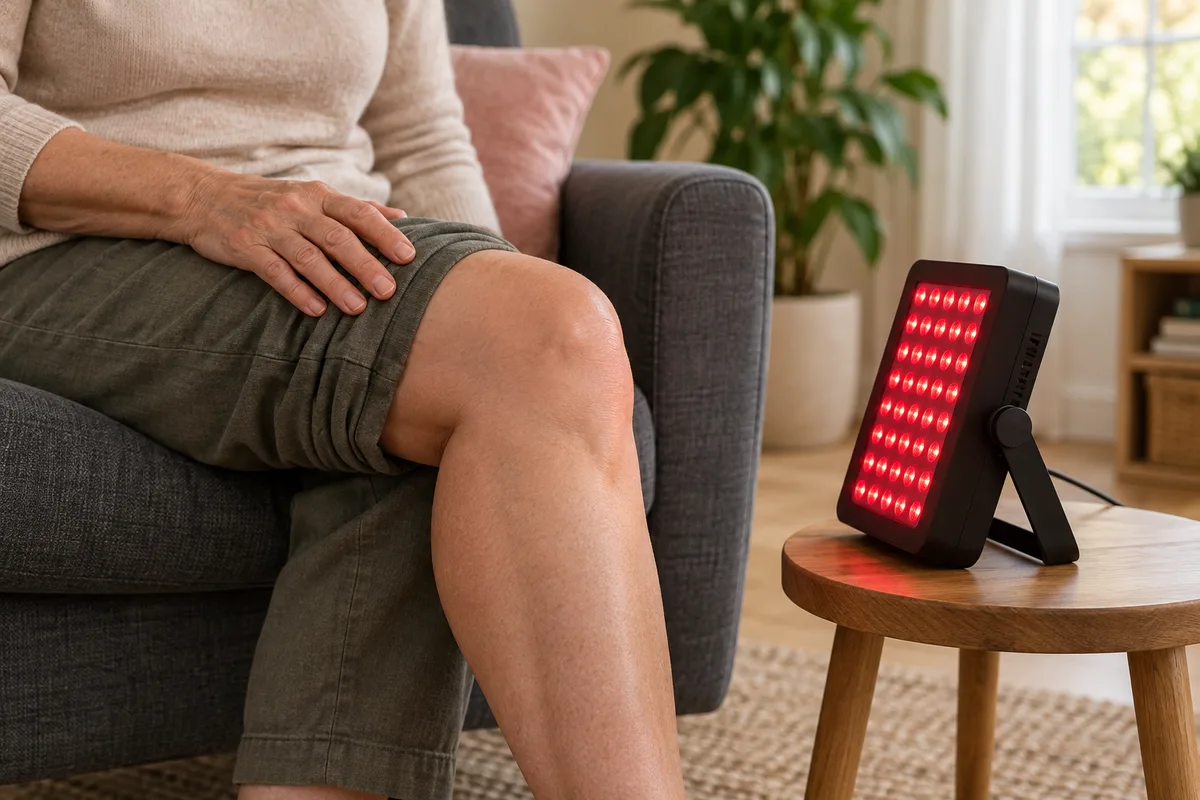
Stairs have become something you plan around. Getting up after a movie takes a moment. You can still do most of your day, but your knee keeps asking for adjustments.
That is often when red light therapy for knee pain starts to sound appealing. A treatment you could use at home, without another appointment, would be welcome.
Some clinical studies suggest photobiomodulation may help knee osteoarthritis symptoms, but results are mixed. Research using a particular laser or treatment protocol does not establish that an ordinary home panel will deliver the same benefit. Positive trial, trial finding no added benefit.
Before deciding whether it belongs in your routine, three questions deserve separate answers: What caused the knee pain? What treatment was actually studied? And did people improve in ways that mattered to everyday life?
What is red light therapy for knee pain?
Red light therapy sits within a wider treatment category called photobiomodulation, often shortened to PBM. It uses red or near-infrared light, delivered through LEDs, low-level lasers, or combinations of the two.
The term can describe quite different equipment. A clinician placing a small laser probe at selected points around a knee is delivering a different treatment from someone sitting in front of an LED panel.
For example, one knee osteoarthritis trial used a combined laser-and-LED device alongside exercise. Another used a 790-nanometer laser at nine knee locations. These details describe the studies, not a home treatment prescription.
The label "red light" tells you less than the complete treatment setup. For the wider picture beyond joints, our overview of red light therapy benefits covers skin, sleep and recovery uses too.
What does the research show?
The 2025 review separates pain from disability
A 2025 umbrella review in Systematic Reviews examined earlier meta-analyses. For knee osteoarthritis, it rated evidence for reduced pain as low certainty and evidence for improved disability as moderate certainty.
Low certainty means confidence in the estimated effect is limited. Moderate certainty means greater confidence, with meaningful uncertainty remaining. Neither rating guarantees an individual response.
The authors also described the pooled knee-pain effect as very small. Statistical significance does not necessarily mean an improvement someone would notice.
Although published in 2025, the review's search ended on December 8, 2023. It is a useful overview, not a complete account of subsequent research.
Individual trials show why the answer stays cautious
The studies below illustrate the range of findings. They are not a complete systematic review.
| Study | What was tested | What it found |
|---|---|---|
| 2018 trial, 60 participants | Exercise with active laser-and-LED treatment, exercise with placebo treatment, or exercise alone over five weeks. | Active treatment added a clinically meaningful pain benefit. Comparable benefits were not demonstrated for function, strength, balance, or pressure-pain threshold. |
| 2023 trial, 127 participants | An eight-week exercise program with active PBM, placebo PBM, or exercise alone, with follow-up through six months. | Adding PBM did not improve pain, physical function, or quality of life more than the comparison groups. |
| 2025 trial, 65 participants analyzed | A targeted low-level laser compared with sham treatment and no intervention. | The published abstract reports greater pain reduction with active treatment and improvements in several symptom and function measures. It studied a specific laser protocol. |
These results support a qualified answer: PBM has shown benefits in some settings, but an additional benefit cannot be assumed. The 2025 trial was assessed here from its publicly available abstract, which limits detailed appraisal.
Why pain relief and daily function are different outcomes
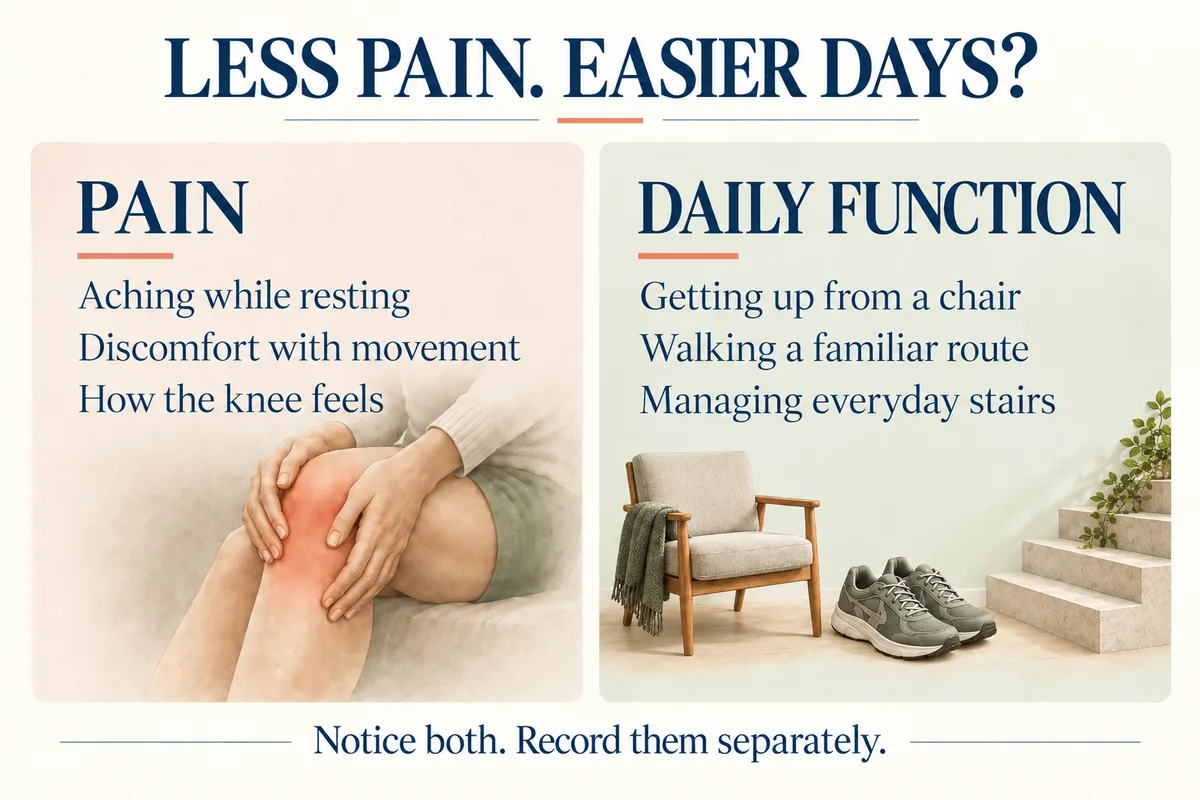
A pain score asks how much your knee hurts. Function asks what you can do with it.
You might notice less aching while sitting, yet still struggle to get out of a low chair. Or walking might become easier even though the pain number changes only a little.
That distinction appeared in the 2018 trial: the extra benefit was in pain, without clinically meaningful added improvements in the other reported measures.
For your own records, choose a familiar activity that matters to you, such as:
- Getting up from your usual chair.
- Walking your regular short route.
- Using the stairs you already encounter.
- Standing long enough to prepare a simple meal.
Record how manageable it feels alongside pain. You do not need to push through symptoms or attempt a difficult activity to test a treatment.
"My knee hurts less" and "I can manage my ordinary day more comfortably" are both useful observations. Keeping them separate makes a follow-up conversation more informative.
Why clinic laser research does not automatically apply to home panels
The practical inference from these trials is that the treatment details matter. Sharing a wavelength does not make two devices equivalent.
| Detail to compare | Why it matters when reading a claim |
|---|---|
| Light source | A laser probe, LED wrap, and panel may deliver light differently. |
| Treatment location | A study may target specific points, while a panel exposes a broader area. |
| Output and exposure | Session length alone does not describe the amount of light delivered. |
| Position and distance | A skin-contact protocol is not reproduced simply by facing a panel toward the knee. |
| Treatment schedule | A defined course of supervised sessions is different from an unspecified home routine. |
| Other care | Benefits observed alongside exercise cannot automatically be attributed to light alone. |
The positive 2025 trial used a measured dose at individual points. Applying those numbers to a different device would require information and expertise that a general blog article cannot supply.
This does not establish that home panels never help. It means the evidence needs to match the device, condition, and way it is used before a strong claim is justified.
Does that mean you should buy a device?
The research does not support telling every person with knee pain to buy one.
There is also a relevant guideline to weigh. NICE's osteoarthritis guideline, NG226, advises against offering laser therapy for osteoarthritis because evidence of benefit is insufficient. That is a UK clinical recommendation, rather than a ruling about every home LED product, but it is an important part of an honest evidence discussion.
If you are considering a purchase, ask the provider or manufacturer:
- Was this exact device studied in people with knee osteoarthritis? Ask for the publication, not just a testimonial.
- What was the comparison? Improvement from the starting point is less informative than improvement beyond a credible placebo or usual-care group.
- What improved? Pain, walking, and a laboratory marker answer different questions.
- Does the proposed home routine match the research? Check the device and application method, not only the wavelength.
- What will the whole trial of treatment cost? Include accessories, appointments, return conditions, and the time involved.
A practical decision also depends on what that spending would displace. Discuss the options with your clinician, especially if the same budget could support an assessment or rehabilitation you already need. If you get that far, our red light device reviews explain what to look for on a spec sheet before you compare specific panels.
Keep the rest of your knee care in place
Osteoarthritis care is built around your symptoms, abilities, and medical circumstances. The National Institute of Arthritis and Musculoskeletal and Skin Diseases describes a combination of physical activity, weight management where appropriate, physical therapy, and medicines or other treatment when needed.
An activity plan might include strengthening, mobility work, or suitable low-impact movement. The right starting point depends on your knee and overall health. Ask a physical therapist to help if you are unsure what is manageable.
If you and your clinician decide to try light therapy, keep prescribed treatment in place unless your care team changes it. Record those changes when they happen.
For the seasonal side of this problem, our guide to cold weather and arthritis covers weather research and everyday adjustments. This article focuses on the evidence for light treatment itself.
How to track whether anything useful is changing
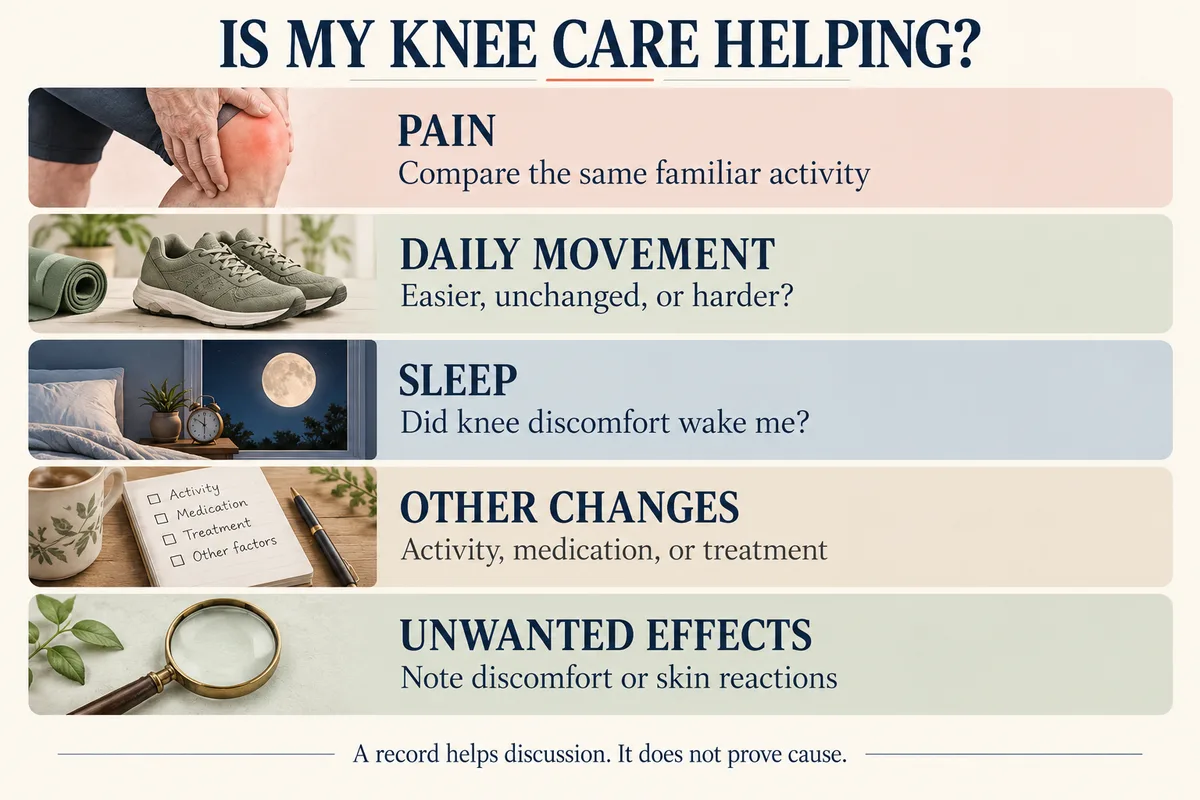
A simple record can make the decision clearer. It cannot prove which treatment caused an improvement, but it can help you describe your experience accurately.
Start with your usual pattern
Before introducing an optional treatment, note a few ordinary days if practical. Do not delay necessary care to collect a baseline.
Choose one everyday task you already do and one consistent way of describing pain. A short written description works; a 0-to-10 score is another option.
Keep the record brief
| What to record | A useful prompt |
|---|---|
| Date and treatment | What did I use, and did I follow the agreed instructions? |
| Pain | How did the knee feel during the same familiar activity? |
| Daily function | Was that activity easier, unchanged, or harder? |
| Stiffness and swelling | What was different from my usual pattern? |
| Sleep | Did knee discomfort interrupt the night? |
| Other changes | Different activity, exercise, medication, illness, or another treatment? |
| Unwanted effects | Any discomfort or skin reaction during or after use? |
If disrupted nights are part of the picture, the LGW sleep diary guide can help you record them without relying on memory.
Agree on a review point
Ask your clinician what would count as worthwhile improvement and when to reassess. There is no universal home-panel trial length established by the studies described here.
Look across repeated observations. One unusually good afternoon is difficult to interpret. Likewise, if you started rehabilitation and changed medication at the same time, improvement does not tell you how much the light contributed.
If nothing useful changes, or treatment causes problems, discuss whether to stop. Increasing exposure on your own is not a reliable way to resolve an uncertain response.
Safety questions to settle before starting
The American Academy of Dermatology's red-light safety guidance recommends following the device instructions and using the specified eye protection when required. It also flags light-sensitive conditions and medications that increase light sensitivity. Its guidance concerns skin treatments, not proof of knee-pain effectiveness.
Ask your doctor or pharmacist whether your conditions, medicines, or other treatment affect suitability, especially if you are pregnant or breastfeeding, take blood thinners, antidepressants, or other regular medication, or have diabetes, poor circulation, or a skin condition that reacts to light. If you are receiving cancer treatment, ask your oncology team before using a device over a painful area.
Stop using a device that causes burning, a skin reaction, or worsening symptoms and seek advice. Do not interpret discomfort as evidence that the light is working.
This article provides general information and does not replace individual medical assessment or treatment.
When knee pain needs assessment instead of another session
Seek urgent medical advice for severe knee pain, inability to move the knee or bear weight, major swelling or a change in shape, or a knee that locks or gives way. A hot or red knee with fever or feeling unwell also needs urgent assessment. These are among the NHS warning signs for knee pain.
Persistent or unexplained pain also deserves assessment. The osteoarthritis studies discussed here do not establish treatment for an injury, infection, or another cause of knee pain.
Frequently asked questions
- Does red light therapy work for knee osteoarthritis?
- Some clinical protocols have produced benefits, while others have not added improvement beyond exercise. It remains an uncertain option to discuss with a clinician, and findings cannot be transferred automatically to a particular home device.
- How long does it take to help knee pain?
- The trials above assessed courses lasting weeks, with different schedules and follow-up periods. They do not establish a dependable response time for a home panel. Ask what review period fits your circumstances and device.
- How many minutes should I use a red light panel on my knee?
- There is no universal session length supported by these studies. Follow the device's instructions and your clinician's advice. A treatment time from a laser study should not be copied onto an unrelated panel.
- Can red light therapy rebuild knee cartilage?
- The evidence summarized here does not establish that a consumer home device rebuilds knee cartilage or reverses osteoarthritis. Improvement in pain or function does not, by itself, demonstrate structural repair.
- Is a wrap better than a panel?
- The evidence reviewed here does not establish a general winner. Compare research on the actual device, its intended use, comfort, instructions, and costs. Shape alone is not proof of clinical benefit.
Make the next step specific to your knee
Before buying anything, write down the ordinary activity you most want to make easier. Take that goal, your current care plan, and the details of any proposed device to your clinician.
Ask: "Would this add something useful to my care, and how would we decide?"
If you want a starting point before that conversation, our red light therapy quiz walks through your goals, your gear, and your medications in about two minutes.
That gives you a practical basis for a decision, with your daily life at the center of it.